
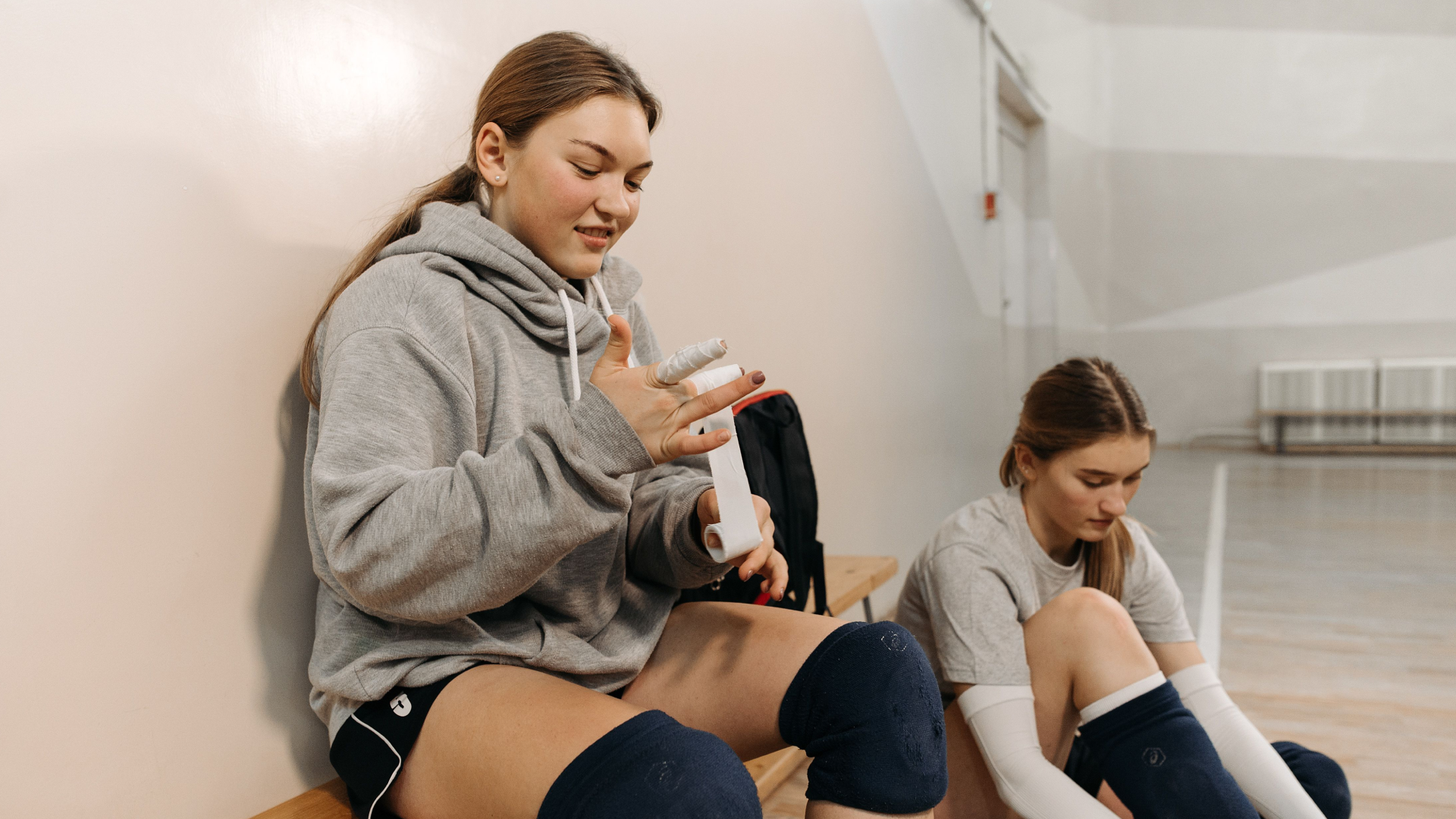
Train Strong. Move Well. Stay in the Game.
If you play sports that involve sprinting, jumping, landing or changing direction, looking after
your knees and other joints is really important.
Female athletes have a higher risk of some knee injuries, including ACL injuries, in certain
sports. Scientists are also studying whether changing hormones during the menstrual cycle
could play a part.
Your Cycle &; Your Joints
Hormones such as estrogen change throughout your menstrual cycle.
Researchers think these hormonal changes might affect how ligaments and other tissues
behave, but there's still lots to learn.
So, does that mean you should avoid training at certain times?
❌ No!
There are no proven “danger days” when every female athlete should stop training or
competing.
Your cycle is personal. The best approach is to learn how your own body feels while
continuing to build strength and good movement skills.
1. Make Your Warm-Up Count
Don't just jog around the pitch and call it a warm-up!
A neuromuscular warm-up trains your brain and muscles to react quickly and control your
body.
Include:
Strength — build your glutes, hamstrings and legs.
Landing skills — practise landing softly and under control.
Knee control — keep your knees lined up with your feet when jumping, landing and
changing direction.
⚖️ Balance — practise controlling your body on one leg.
↔️ Change of direction — learn how to slow down, turn and accelerate safely.
Did you know?
Good neuromuscular training programmes have been shown to reduce ACL injuries in female
athletes by around 61%.
Even 10 minutes at least twice a week can form part of an effective injury-prevention
programme.
Small warm-up. Big benefits.
2. Learn Your Patterns
Your menstrual cycle might affect how you feel, even if it doesn't automatically change what you
can do.
Try tracking:
Period — where are you in your cycle?
Energy — full of energy or running on empty?
Sleep — did you sleep well?
Muscles — fresh, stiff or sore?
Focus — sharp or struggling to concentrate?
Training — did today's session feel easy, normal or harder than usual?
After a few months, you may notice your own patterns.
Use the information — don't fear it.
Feeling great? Train as normal.
Feeling unusually tired, sore or unfocused? Tell your coach, make your warm-up count and
pay attention to your recovery.
Your cycle tracker should be a tool for understanding your body, not a reason to
automatically miss training.
3. Fuel Like an Athlete
Your body needs energy for:
Training
Building muscle
Building strong bones
Concentrating
Growing and developing
Recovering
That's a lot!
If you're regularly training hard but not eating enough, your body might not have enough
energy left for everything else it needs to do.
This is called low energy availability.
If it continues, it can contribute to RED-S (Relative Energy Deficiency in Sport).
RED-S can affect your:
Bones
Periods
Recovery
Energy
Performance
Risk of injury and illness
Food is fuel.
Don't regularly skip meals or cut out major food groups just because you're an athlete.
Aim for a balanced diet containing carbohydrates, protein, healthy fats, fruit and
vegetables, alongside enough fluids.
4. Don't Forget Hydration
Water helps your:
Muscles work
Brain stay focused
Body control its temperature
Blood circulate
Body perform during exercise
You'll lose water when you sweat, so drink before, during and after training as needed.
A simple check?
Pale-yellow wee = usually well hydrated.
Your Stay-in-the-Game Checklist
Before worrying about which day of your menstrual cycle you're on, focus on the things you can
control:
WARM UP — prepare your body properly.
GET STRONG — train your whole body, including your glutes and hamstrings.
MOVE WELL — practise jumping, landing and changing direction.
FUEL — eat enough to support training and growth.
HYDRATE — replace the fluids you lose.
RECOVER — sleep and rest are part of training.
TRACK — learn how your body responds throughout your cycle.
SPEAK UP — tell a parent, coach or healthcare professional if something doesnt feel right.
⭐ Remember
Your period shouldn't stop you playing the sport you love.
Understanding your cycle is about learning more about your body — then combining that
knowledge with smart training, good nutrition and proper recovery to help you perform at
your best.